
 English
 Español
 Français
 Português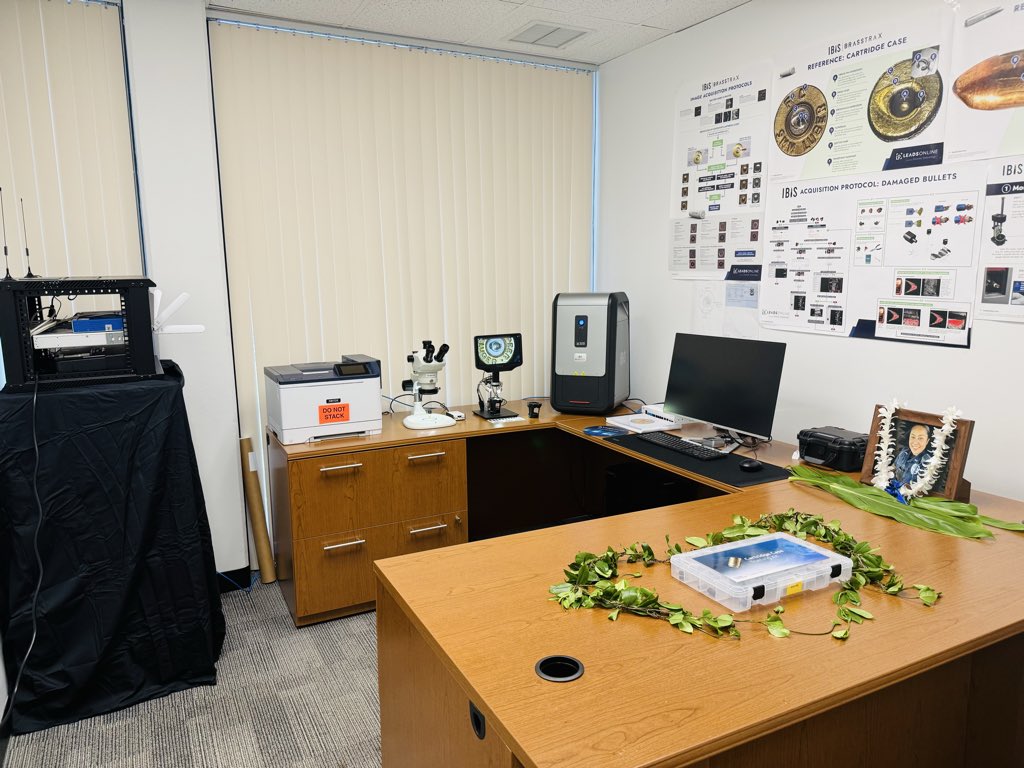
She never made it home from that shift.
On August 15, 2025, Officer Suzanne O of the Maui Police Department responded to a terroristic threatening call in Pāʻia. A groundskeeper had reported that a trespassing suspect fired multiple shots at him near an old property. Officer O went to work. She was searching the scene — doing exactly what officers do — when the suspect, concealed behind a concrete pillar, opened fire. The bullet struck her chest, just one inch above her ballistic vest. She was five years on the job. She wanted to be a role model for young women from the Pacific Islands. She was 37 years old.
Less than ten months later, Hawaii unveiled its first-ever NIBIN site. And they put her name on the door: The Officer Suzanne O NIBIN Site - Honolulu.
Not a plaque. Not a moment of silence once a year. A working intelligence system that will connect crime scenes, identify repeat shooters, and disrupt cycles of violence across the islands for decades to come. That is what her name is attached to now.
Takeaway 1: The Last State to Get There — And Why It Took So Long
Hawaii was among the last states in the nation to join NIBIN. The National Integrated Ballistic Information Network has existed since 1997. It has connected cases across more than 418 locations. It has linked seemingly unrelated shootings, exposed repeat violent offenders, and built investigative roadmaps for detectives who otherwise had nothing. And yet, for years, when a police officer in Honolulu or Maui or Hilo recovered a spent cartridge casing at a crime scene, that casing went into a box. It got shipped to the mainland. And then they waited. Days. Sometimes weeks. Sometimes the case went cold.
That was not a technology failure. That was a resource and infrastructure gap — one that leaders like Mike Lambert, Director of the Hawaii Department of Law Enforcement, spent years working to close. The machine costs roughly $250,000. The ATF stepped in. Federal partners aligned. And on June 9, 2026, at DLE headquarters on South King Street in Honolulu, they held a blessing ceremony — with Officer O’s brother in the room — and Hawaii finally entered the network.
“We haven’t had this technology, ever, and we’re grateful to our friends at HIDTA and ATF to fund this project so that we can keep Hawaii one of the safest states in the nation.” — Mike Lambert, Director, Hawaii Department of Law Enforcement
The lesson here is not about the delay. It is about what happens when the right leaders refuse to accept the gap as permanent.
Takeaway 2: One System. Four Counties. Zero Gaps.
Before this week, each of Hawaii’s four county police departments — Honolulu, Maui, Hawaii County, and Kaua’i — had their own separate policies and procedures for handling ballistic evidence. Different chain-of-custody protocols. Different timelines. Different standards. No shared intelligence picture.
A shooter who fired a weapon in Honolulu and moved that gun to Maui? That connection lived in no system. It lived nowhere, except maybe in a detective’s gut.
That changes now. All four county departments are tied into the same system, feeding evidence into a shared network under a standardized statewide protocol built specifically to ensure chain-of-custody integrity and courtroom admissibility. When a casing hits the machine and the system flags a match, that lead surfaces to investigators across county lines — in near real time.
“This NIBIN site means faster access to critical investigative information. Instead of waiting weeks or months for connections to emerge, officers and technicians can develop this in near real time, helping them identify suspects, solve cases and prevent future acts of violence.” — Jonathan Blais, ATF Special Agent in Charge
This is the architecture of intelligence. Not silo. Not province. Network.
Takeaway 3: The Ghost Gun Problem Just Got a Better Answer
Here is a number that should get your attention: ghost gun seizures in Hawaii jumped from 52 to 88 in a single year — a nearly 70 percent increase. Privately manufactured firearms. No serial numbers. No ATF trace. No origin story.
For investigators, a ghost gun has traditionally been a dead end. You recover it, you know it was used, and then you know almost nothing else. Trace goes nowhere. The gun’s history is a blank page.
NIBIN changes the equation. The system does not care whether a firearm has a serial number. It reads the microscopic toolmarks — the unique signature left on a cartridge case by the breech face, the firing pin, the ejector. Every gun leaves a fingerprint. Ghost guns included. When the same ghost gun shows up at two scenes, NIBIN finds it. When it shows up at three, you’re starting to build a case.
Lambert said it clearly: Hawaii doesn’t know how many illegally manufactured firearms are circulating in the state. NIBIN will start answering that question — casing by casing.
Takeaway 4: Speed is the Point — Not Just Accuracy
There is a rhythm to retaliatory violence. Shooting happens. Word travels. People arm up. The next shooting comes within hours or days. That cycle is predictable — if you have the intelligence to see it coming.
The old Hawaii model — box the casing, ship it to the mainland, wait for a result — broke that cycle in exactly the wrong direction. By the time the analysis came back, the investigation was already cold, and any chance of preempting the follow-on violence had passed.
NIBIN is built for speed. Leads generated in hours. The same gun used at three different scenes across the islands? You know about it by morning. Investigators can pull video, canvass witnesses, and move resources — before the next shot is fired.
This is not just about solving what happened. It is about stopping what comes next. That distinction matters more than almost anything else in violent crime investigation. And now Hawaii has the tool to make it real.
Takeaway 5: A Legacy That Keeps Working
Officer Suzanne O grew up in Pago Pago, American Samoa. She was fluent in Samoan. She graduated high school in Oʻahu, studied criminal justice, and joined the Maui Police Department in December 2020. She served on the Honor Guard. She volunteered on her days off to help with calls for service when the unit was stretched. She wanted to show Pacific Islander girls that this career was possible for them.
She was exactly the kind of officer every department hopes to build.
When Maui County Deputy Police Chief Wade Maeda spoke at the dedication ceremony, he said: “Losing Suzanne O was a devastating thing that happened to Maui police and we’re only slowly recovering now, but to have this NIBIN system when it didn’t exist in Hawaii is a huge step forward.”
The department could have put her name on a plaque. Or a park bench. Or a memorial wall. Those things have their place.
They chose differently. They put her name on a crime gun intelligence lab. On a system that will generate leads, connect shootings, and keep working long after the ceremony ends. Every casing entered into that machine. Every hit confirmed. Every arrest that follows. That is Officer O’s legacy — active, not archived.
There is a particular kind of honor in that. A memorial that does something. A name that keeps showing up in investigations. A presence that cannot be erased because it is written into the work itself.
Conclusion: Hawaii Is In the Network — Now the Real Work Begins
The blessing ceremony on June 9th was the beginning, not the finish line.
Every state that joined NIBIN had a first day. The states that got the most out of it were the ones that treated that first day as the launch of a discipline — not a one-time win. Consistent evidence entry. Rapid lead turnaround. Cross-agency communication protocols. Detectives who know how to act on a NIBIN lead within hours, not weeks. That infrastructure takes time to build. Hawaii now has the machine. The harder work is building the habits.
But the foundation is right. Four counties aligned. Federal partnership in place. A statewide chain-of-custody standard being built. And a name on the door that carries real weight — the kind of weight that reminds people, every time they walk in, why this work matters.
The question for every law enforcement executive and crime gun intelligence professional reading this is straightforward:
Are you working your NIBIN the way Hawaii just committed to working theirs? Or is the machine in your building just a box that checks a grant requirement?
Because the casings are accumulating either way. The only question is whether you’re listening.Or consider this ending:
But the foundation is right. Four counties aligned. Federal partnership in place. A statewide chain-of-custody standard being built. And a name on the door that carries real weight - the kind of weight that reminds everyone who walks through it why this work matters. It is a weight of conscience: a commitment to make the Officer Suzanne O NIBIN Site in Honolulu the very best it can be.
The question for every law enforcement executive and crime gun intelligence professional reading this is straightforward: Are you operating your NIBIN program the way Hawaii has committed to operating theirs? Or is the machine in your building simply another box checked to satisfy a grant requirement?
The cartridge cases will continue to accumulate either way. The only question is whether they become intelligence that helps stop the next shooter—or evidence that sits on a shelf until it's too late.
So, what's weighing on your conscience?